Digital success today depends on choosing the right foundation. Many businesses assume a website and a web application are the same thing, but this misunderstanding often leads to wasted budgets, delayed launches, and tools that fail to meet real needs.
Websites and web apps serve very different purposes. Knowing which one your business needs is not just a technical decision; it’s a strategic and financial one.
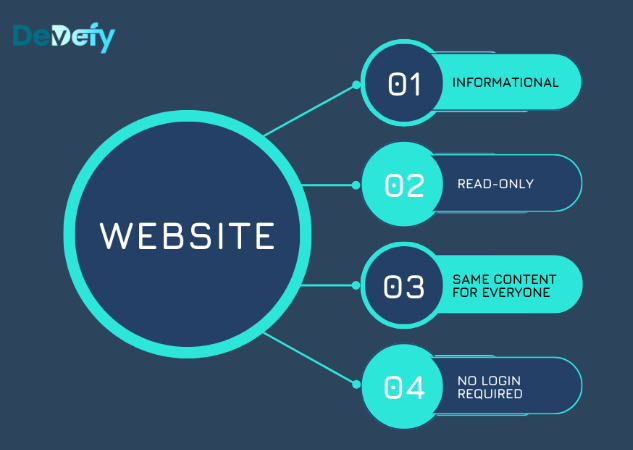
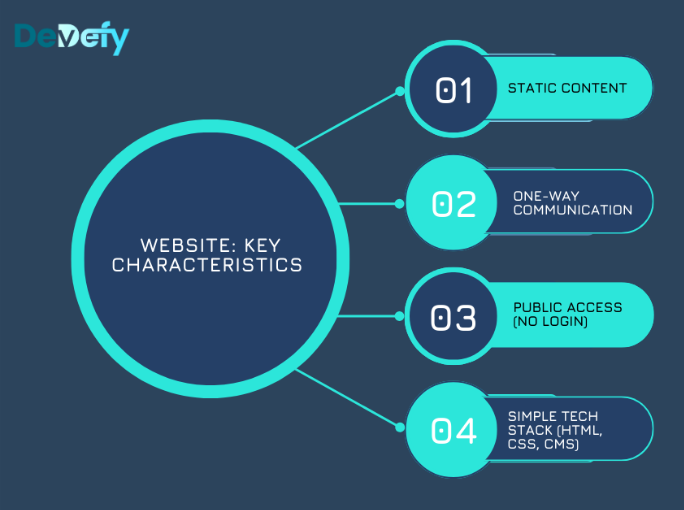
A website is a collection of interconnected pages accessed through a web address (URL). Its primary purpose is to share information.
Most users interact with websites passively. They land on a page, read content, click links, and leave. Think of a website as a digital brochure or information hub.
Websites are best suited for presenting fixed or semi-static content, such as:
News platforms, company pages, or educational sites that deliver content without user interaction.
Regularly updated articles, but interaction is limited to reading or commenting.
Used by designers, writers, and creatives to showcase work and skills.
Customers can easily find your services, contact details, and brand story.
Websites are essential for ranking on Google and attracting organic traffic.
A web application (web app) is an interactive, task-driven platform that allows users to input, process, and manage data online similar to software you’d normally install on your computer, but accessed through a browser.
Unlike websites, web apps are built for action, personalization, and automation.
Online stores with user accounts, carts, and payment processing.
Tools like Google Docs, Trello, or financial dashboards.
Content updates instantly based on user actions.
Logins are essential to protect personal and sensitive data.
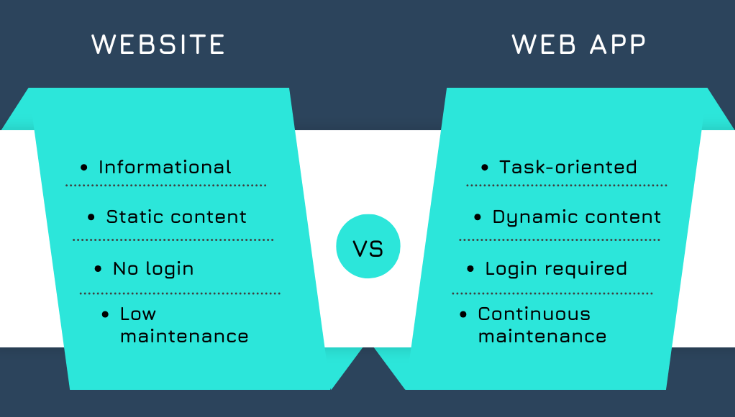
Aspect | Website | Web App |
Interactivity | Low, read-only | High, two-way interaction |
Functionality | Informational | Task-based, data-driven |
Personalization | None | User-specific |
Authentication | Not required | Required |
Technology | HTML, CSS, CMS | Frontend frameworks, backend, databases |
Maintenance | Minimal | Continuous |
Best For | Visibility & content | Operations & user engagement |
Example: Company websites, blogs, landing pages.
Example: SaaS platforms, marketplaces, internal tools. Note that for a SaaS product, you will likely have both a web application and a website. This brings us to our next point…
Yes and many successful businesses do.
A common approach is:
This hybrid model ensures you attract users effectively while delivering powerful digital experiences.
Understanding the difference between a website and a web application is the first step toward building the right digital solution. Choosing incorrectly can lead to unnecessary costs, limited scalability, or poor user experiences.
At DevDefy, we help businesses make the right call from day one. Whether you need a sleek, SEO-focused website or a robust, secure web application, we ensure your investment aligns with your business goals not just trends.
Ready to build the right digital foundation?
Get in touch with DevDefy today and let’s turn your idea into a solution that works.
A website shares static information (like a brochure), while a web application enables users to perform dynamic tasks and manage data (like a tool).
Yes, and this often requires a major overhaul and the addition of complex back-end logic, databases, and user authentication systems.
At DevDefy, we have extensive experience handling these transitions and can help you upgrade your website into a fully functional web application with minimal disruption.