The Math Behind Curtain: Linear Math & AI
AI and Language:
How Linear Algebra Transforms Prompts into Predictions
At the core of modern artificial intelligence lies the math behind AI. Have you ever stopped to think about how artificial intelligence (AI) turns your words into responses? Let’s say you’re typing out a question to a chatbot, or maybe even composing an email with the help of an AI assistant. Within seconds, it seems to understand what you want and spits out a polished, coherent reply. But behind all that polished language is something you can’t see—math. Specifically, linear algebra.
To explain how AI interprets language, let’s start with a simple analogy and work our way up to the math behind AI that makes it possible.
Words as Coordinates: Starting the Journey
Imagine you’re standing in a massive library filled with books, but instead of being organized by traditional categories like “fiction” and “history,” the books are arranged by how closely related they are to one another. In one section, you’ll find books about kings, queens, castles, and knights. In another, you’ll find books about beaches, sunsets, and vacations.
In the AI world, words are like these books—they exist in a massive “space” where their position is determined by how closely related they are to other words. We call these positions vectors, and each word gets a unique vector that represents where it fits in this vast space. For example, “king” and “queen” would be close together because they share similar meanings (both are royalty). Words that are less related, like “king” and “beach,” are further apart in this space.
But what does this “space” look like? It’s not a physical space, but a mathematical one where each word is represented as a list of numbers, like… [2.3, 0.8, -1.4].
This list, or vector, is what AI uses to compare one word to another. Words that are similar—like “king” and “queen”—will have vectors that point in roughly the same direction.
Now, the reason AI can “understand” relationships between words is because it has learned how to map these vectors into a space where similar meanings group together. This process is called word embedding, and it’s a bit like organizing all the books in the library so you can easily find the ones you need based on their content, not just their title.
Building Bridges: How Matrices Help Understand Sentences
Understanding single words is one thing, but AI also needs to understand how words work together in sentences. Here’s where matrices come in. You can think of matrices as tools that help AI look at how words connect to each other in context.
Let’s break it down. Imagine you’re solving a puzzle. You have pieces (the words), but they don’t mean much on their own. To solve the puzzle (understand the sentence), you need to figure out how the pieces fit together. That’s what matrices do—they help the AI figure out the relationships between words.
For example, if you say, “The king rules the kingdom,” the AI doesn’t just see individual words floating in space. Instead, it looks at how “king” is related to “rules” and how “kingdom” fits into the sentence. Matrices are mathematical tools that take these word vectors and transform them, helping the AI determine which words are connected and in what way.
A matrix might, for example, figure out that “rules” is the action being performed by “king” and that “kingdom” is the object affected by that action. In simpler terms, matrices help the AI make sense of how words relate to one another in a sentence.
Think of a matrix as a rulebook that tells the AI how to combine different word meanings based on their order and roles in the sentence. The matrix transforms the word vectors to capture not just what each word means, but how it behaves in context.
The Dot Product and Attention: AI’s Spotlight
Now, let’s say you’ve given the AI a question: “What’s the best restaurant nearby?” The AI doesn’t focus equally on every word. It uses something called attention to figure out which words are most important. This is where a concept called the dot product comes in.
Imagine you’re in a dark room with a flashlight. The brighter you shine the light on something, the more attention you’re giving to it. The AI does something similar with the dot product. It compares the vectors for each word and “shines a light” on the words that are most relevant to the meaning of the sentence.
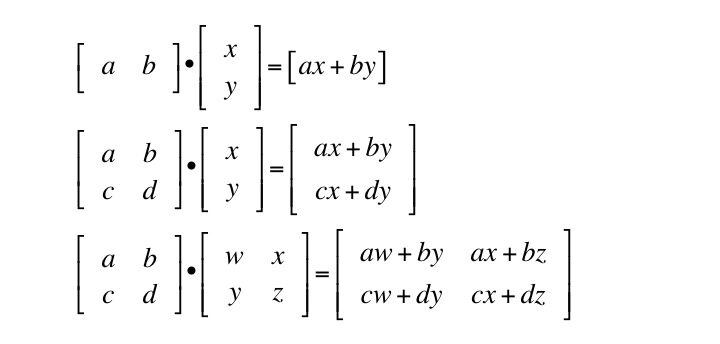
For example, in the sentence “What’s the best restaurant nearby?”, the AI will likely shine more light on the words “best,” “restaurant,” and “nearby” because they are central to the meaning of the question. The dot product is the mathematical operation that tells the AI how related these words are in context, guiding its attention to the right parts of the sentence.
Making Predictions: From Numbers Back to Words
After all this—turning words into vectors, transforming those vectors with matrices, and using the dot product to focus attention—the AI now has a transformed version of your sentence. But how does it give you an answer? This is where predictions come in.
The AI has learned from vast amounts of data, so it knows which words tend to follow others. For instance, if you start a sentence with “The king,” the AI knows from experience that words like “rules,” “commands,” or “leads” are likely to follow.
This part is like autocomplete on your phone, but much more powerful. The AI doesn’t just predict one word—it predicts a whole sequence of words based on the patterns it has seen before. So, if you ask “What’s the best restaurant nearby?” it predicts an answer like, “The best restaurant is Joe’s Diner,” based on how it has learned to respond to similar sentences in the past.
The magic here is that all this is happening in the background—AI takes your words, turns them into numbers, processes those numbers with matrices, and then turns them back into words that make sense in context.
Conclusion: The Math Behind the Curtain
It’s easy to think of AI as an almost magical tool that can understand and respond to anything you say. But in reality, every interaction with a chatbot, search engine, or AI assistant is driven by the math behind AI. Words are converted into numbers, those numbers are processed through matrices and attention mechanisms, and then transformed back into language you can read and understand.
But here’s the interesting part — AI can do all of this without actually “understanding” in the human sense. The math behind AI relies entirely on patterns, probabilities, and mathematical rules, not consciousness or awareness. Because of this, AI cannot become sentient. Sentience requires memory, self-awareness, and the ability to reason abstractly, while AI is limited to pattern recognition and prediction based on past data.
In the end, linear algebra sits at the core of the math behind AI, working quietly behind the scenes to turn your prompts into coherent responses. The next time you interact with an AI, remember that every word you type begins a mathematical journey through vectors, matrices, and probabilities — all guided by the math behind AI to deliver the answers you need.
And for teams looking to turn that math into real, scalable AI solutions, partners like DevDefy help bridge the gap between theory and production. Contact us today!
SHARE ME!
MORE ARTICLES