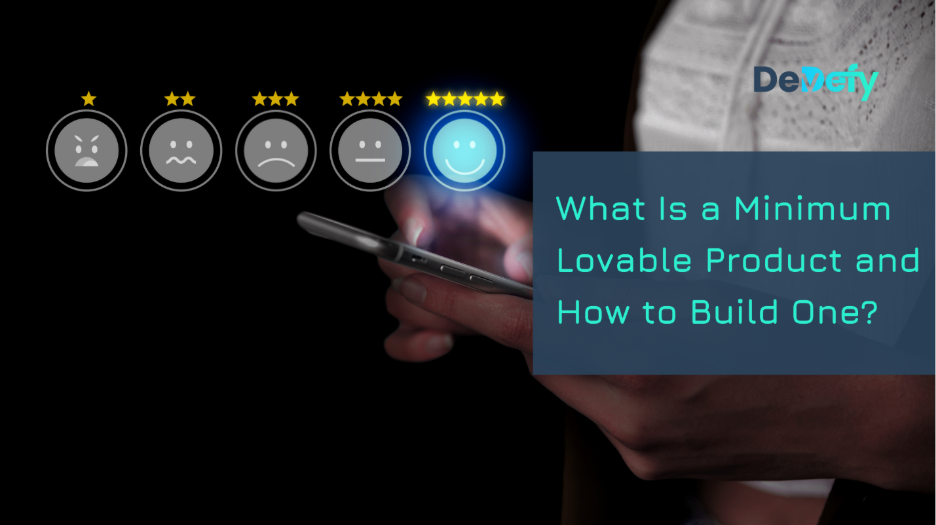
What Is a Minimum Lovable Product and How to Build One?
Let’s be honest for a second. We’ve all downloaded an app, used it for exactly thirty seconds, and then deleted it because it felt… well, “meh.” It worked, sure. It solved the problem it said it would. But it had no soul. It was clunky, the buttons were in weird places, and it felt like it was built by a robot for a robot. That is the risk of stopping at ‘functional’, you miss the magic of a Minimum Lovable Product that actually wins people over.
In the startup world, we’ve been told for years to “fail fast” and build a Minimum Viable Product (MVP); And that advice still holds. MVPs are invaluable for proving utility and usability; they help you validate that a real problem exists and that people are willing to engage with a solution. But an MVP is designed to answer if something should exist, not how it should live in the market. Once that signal is clear, the next challenge isn’t viability – it’s traction, trust, and adoption.
That’s where a Minimum Lovable Product (MLP) comes in. An MLP builds directly on the insights earned from the MVP, refining the experience, reducing friction, and delivering something cohesive enough to confidently go to market. Not as a replacement for the MVP mindset, but as its natural evolution – turning early validation into a product people actually want to keep using.
What is Minimum Lovable Product?
The minimum lovable product definition is pretty straightforward: it’s the most basic version of a product that users don’t just use; they actually love using.
While an MVP focuses on utility (Can it do the job?), an MLP focuses on delight (Does it feel good to use?). Think of it as the version of your product that hits that sweet spot between “I need this” and “I love this.” It’s not about adding a million features; it’s about making the three features you do have so smooth, beautiful, and intuitive that people can’t help but tell their friends about it.
Why Should You Build an Minimum Lovable Product?
You might be thinking, “Won’t building an MLP take more time and money than a quick MVP?”
Maybe a little. But the ROI of being “lovable” is massive. Here’s why you should care:
1. Retention is King:
People stick with what they love. If your product is just “viable,” users will jump ship the second a slightly better (or prettier) version comes along. An MLP builds emotional “stickiness.”
2. Organic Growth (The Referral Loop):
Nobody goes to a dinner party and talks about a “viable” calculator app. They talk about the app that made their life easier and looked gorgeous doing it. Love leads to word-of-mouth marketing, which is the cheapest growth hack on the planet.
3. Better Feedback:
When users love a product, they want it to succeed. They’ll give you better, more thoughtful feedback because they’re invested in your journey.
4. Stand Out in a Crowded Room:
There are probably ten other apps doing what you do. Being the “lovable” one is often your only real competitive advantage.
MLP vs. MVP: The Big Showdown
MVP and MLP both serve important purposes in product development. To understand the difference, let’s look at them side-by-side:
Feature
Minimum Viable Product (MVP)
Minimum Lovable Product (MLP)
Core Focus
Functionality & Validation
Delight & Emotional Connection
Goal
“Does it work?”
“Do they love it?”
Design
Basic / Wireframe level
High-end UI/UX
User Reaction
“This is useful.”
“This is amazing!”
The Coffee vs. Cappuccino Example
If you’re still a bit fuzzy on the difference, let’s talk about your morning caffeine fix.
The Black Coffee (The MVP)
Imagine you’re running late, you’re exhausted, and you just need caffeine. However, you grab a cup of plain, lukewarm black coffee from a gas station.
Is it viable?
Yes. It has caffeine. It will wake you up.
Do you love it?
No. You’re drinking it out of necessity. You won’t remember the brand, and you definitely won’t post a photo of it on Instagram.
The Perfect Cappuccino (The MLP)
Now, imagine you walk into a local cafe. The barista smiles, the shop smells like roasted beans, and you’re handed a cappuccino with a perfect heart made of foam on top. It’s warm, the cup feels nice in your hand, and the first sip is heaven.
Is it the minimum?
Yes. It’s still just a cup of coffee. It doesn’t have gold flakes or a three-course meal attached to it.
Is it lovable?
Absolutely. You’ll probably come back tomorrow. You might even tell a coworker about “that great little spot on the corner.”
The lesson?
Both solve the problem of “I am tired,” but only one creates a customer for life.
Key Elements of a Minimum Lovable Product
Functionality:
The “must-have” core that ensures your product actually solves the problem it promised to fix.
Usability:
A smooth, frictionless experience that’s so intuitive your users never have to guess the next step.
Delight:
That extra “spark” or emotional hook that turns a boring task into something users genuinely enjoy.
When building an MLP, functionality and usability still matter, but delight is what makes it unique and more powerful.
How to Build Your MLP (Step-by-Step)
Step 1: Find the "Emotional Gap"
Don’t just look at what features your competitors are missing. Thus, look at how they make people feel. Are their users frustrated by the complexity? Are they bored? Your MLP should aim to solve that emotional pain point.
Step 2: Define the "Must-Love" Features
In an MVP, you list “Must-Have” features. In an MLP, you list “Must-Love” features. What is the one interaction that will make a user smile? Focus your energy there.
Step 3: Design with Empathy
Use tools like Userpilot (or proprietary reporting tools) to see where users get stuck. Design your flow to be as frictionless as possible. If a user has to click five times to do something that should take two, you’ve lost the “love.”
Step 4: The 80/20 Rule for Aesthetics
You don’t need a million-dollar design budget. Spend 80% of your design effort on the 20% of screens your users see the most. Make your home screen and your core action screen absolutely stunning.
Step 5: Listen, Pivot, and Polish
Launch your MLP to a small group of early adopters. Don’t ask them “Does it work?” Ask them “How does this make you feel?” Use their emotional feedback to polish the rough edges.
Takeaway
At the end of the day, building a product is hard work. Why spend months of your life building something that people only “tolerate”?
The development from MVP to MLP is a shift in mindset. It’s about moving from “What can we build?” to “Who are we building for?” When you lead with love, growth, retention, and success tend to follow naturally.
Frequently Asked Questions (FAQs):
Is an MLP more expensive than an MVP?
Not necessarily. It’s about where you spend your budget. Instead of building 10 basic features, you build 3 features that are incredibly well-designed and polished.
How do I know if my product is "lovable"?
Check your retention rates and NPS (Net Promoter Score). But also, look at the qualitative feedback. Are users saying “This is okay” or are they saying “I can’t live without this”?
Can I turn my existing MVP into an MLP?
Absolutely! In fact, most great products evolve this way. Look at your most used feature and ask: “How can we make this experience 10x more delightful?”