What a Discovery Phase Is and Why Every Project Needs One

Starting a software project without a plan is like building a house without a blueprint. You might end up with walls and a roof, but if the foundation is weak, the whole structure will collapse.

Many organizations feel the pressure to “hit the ground running” and start coding immediately. However, rushing into development without a validated roadmap is a primary cause of budget overruns, missed deadlines, and scope creep. To mitigate these risks, industry leaders prioritize a preliminary stage known as the discovery phase.

What Is a Discovery Phase?

Think of it as the architectural blueprint for a complex building. You would not order materials or break ground without a detailed floor plan, structural analysis, and interior design. Similarly, the discovery phase of a project ensures that you do not build a software solution that collapses under its own technical weight or fails to meet user needs.

During a software development discovery phase, a cross-functional team collaborates to answer three critical questions:

A discovery phase is the foundational stage of the software development lifecycle (SDLC) that occurs before any development work begins. It is a period dedicated to information gathering, technical research, and strategic planning.

What are we building? (Scope and Features)

Who are we building it for? (Target Audience) 

How will we build it? (Technology Stack and Architecture) 

Why Is It Critical for Your Project?

Skipping the discovery phase in software development often leads to “uncertainty penalties”; costs incurred later in the project due to changes that should have been identified earlier. Here is why this phase is essential for protecting your ROI:

Risk Mitigation:

It identifies potential technical bottlenecks, third-party integration issues, and regulatory constraints early, when they are cheap to fix. 

Accurate Budgeting:

It replaces vague “guestimates” with precise financial forecasts. You cannot accurately price a product until you have fully defined the scope.

Scope Control:

It clearly defines the Minimum Viable Product (MVP), preventing “scope creep” where features are continuously added, bloating the budget and delaying the launch.

Stakeholder Alignment:

It ensures that investors, business leaders, and the technical team are all aligned with the final vision.

Who Is Involved?

A successful discovery phase of a software project is a collaborative effort. It requires input from both the business side (the client) and the technical side (the development partner).

The Core Team Typically Includes:

Business Analyst (BA):

The bridge between business and tech. They interview stakeholders, gather requirements, and document user needs.

Solution Architect:

The technical lead who designs the system architecture, selects the database, and chooses the right tech stack (e.g., AWS vs. Azure, React vs. Angular).

UI/UX Designer:

Responsible for the UX discovery phase, ensuring the product is intuitive and visually appealing.

Product Owner:

The decision-maker from the client’s side who defines the vision and priorities.

How to Conduct a Discovery Phase (Step-by-Step)

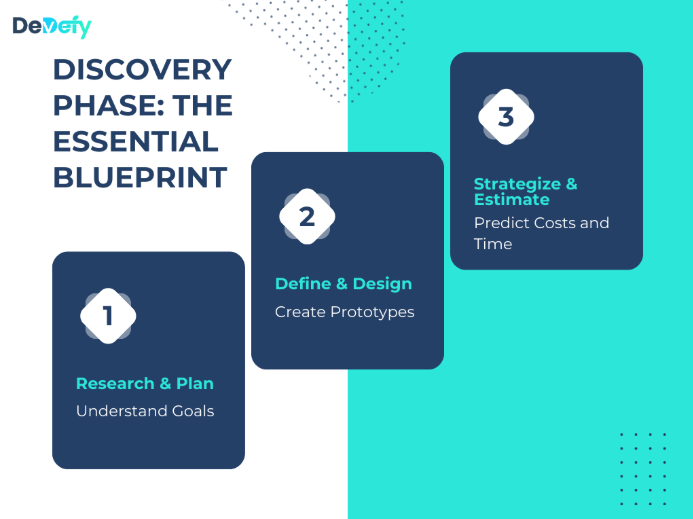
While every project is unique, a professional product discovery phase typically follows a structured four-step process. 

Step 1: Workshops and Stakeholder Interviews

The process begins with deep-dive sessions. The team conducts interviews with key decision-makers to extract the product vision.

Action:

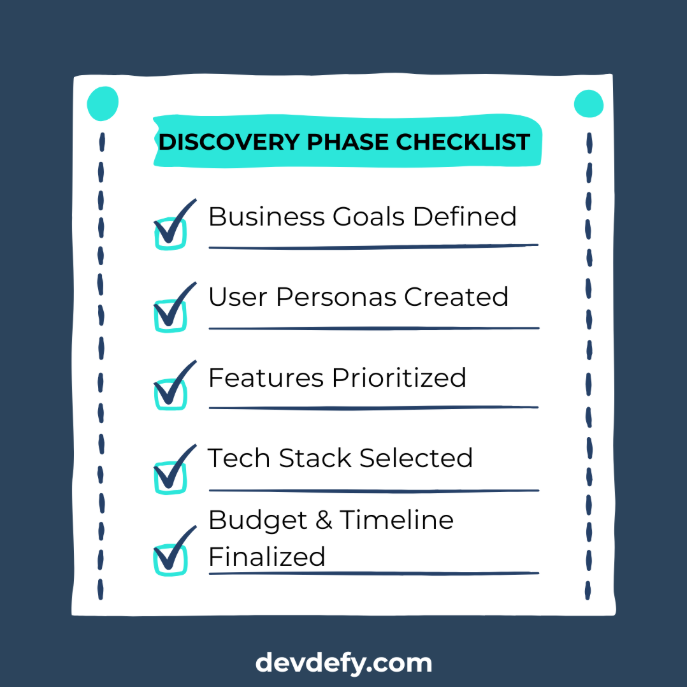
Define high-level business goals and Key Performance Indicators (KPIs).

Outcome:

A shared understanding of why the project exists and what success looks like.

Step 2: Market and User Research

You cannot build a product in a vacuum. This step involves analyzing competitors and understanding the end-users.

Action:

Create “User Personas” (e.g., specific profiles of your ideal customers) and map out their pain points. Conduct interviews and real-world research to gain a unique understanding of needs, wants, and challenges.

Outcome:

Validation that the product solves a real market problem, and that separate business plans are sound and profitable.

Step 3: UX Discovery Phase Activities

Visualizing the product is crucial before writing code. The UX discovery phase activities focus on how the user interacts with the system.

Action:

Designers create user journeys (flowcharts showing how a user navigates the app) and low-fidelity wireframes.

Outcome:

A visual prototype that allows stakeholders to “see” the product for the first time.

Step 4: Technical Proposal and Roadmap

Once the functional requirements are clear, the technical team determines the best way to build them.

Action:

Select the technology stack, hosting and cloud providers, plan structures, and estimate the development effort.

Outcome:

A technical specification document and a verified timeline.

Core Discovery Phase Deliverables

At the conclusion of the discovery phase, you should receive a comprehensive package of documents. These UX discovery phase outputs and technical files belong to you and serve as the master plan for development. 

Deliverable 

Description 

Why You Need It 

Software Requirements Specification (SRS) 

A comprehensive document listing every feature and function. 

Acts as the “contract” for what will be coded. 

Wireframes & Prototypes 

Visual sketches of the application screens. 

Visualizes the UX discovery phase work. 

Technology Stack 

List of tools, languages, and frameworks to be used. 

Ensures that the app is scalable and secure. 

Project Roadmap 

A timeline showing development milestones. 

Helps you track progress. 

Budget Estimate 

Accurate cost calculation for the full development. 

Essential for securing investment. 


Cost and Duration of Discovery Phase

Founders often ask: How much does it cost?

Duration:

A standard discovery phase in software development typically takes 2 to 6 weeks, depending on project complexity.

Cost:

Cost can vary widely. For many industry providers, it usually costs roughly 20% of the total project budget.

Benefits: What You Get After the Discovery Phase

Completing a discovery phase of a software project gives you leverage and security. 

You walk away with:

Ownership:

You own the code, the designs, and the documentation.

Clarity:

You know exactly when your product will launch and how much it will cost.

Confidence:

You have validated that your idea is technically possible and market ready.

Takeaway

The discovery phase is not merely an administrative step; it is a strategic business tool. It transforms a high-risk gamble into a calculated investment. By dedicating time to a software development discovery phase, you align your business goals with technical execution, ensuring that the final product is delivered on time, within budget, and to the highest standard. 

Frequently Asked Questions (FAQs):

Is a discovery phase necessary for small projects?
Yes. Even for small tasks, a short discovery phase (3–5 days) prevents misunderstandings. It ensures everyone is on the same page before money is spent on coding.
How much does a discovery phase cost?
Typically, it costs about 20% of your total project budget. It is an upfront investment that prevents expensive rework and hidden costs later on.
How long does the process take?
Most discovery phases last between 2 to 6 weeks, depending on how complex your software idea is.

SHARE ME!

MORE ARTICLES

Don’t Build Without a Blueprint

Stop guessing and start building with confidence. Get a clear roadmap, accurate costs, and expert technical strategy from DevDefy.