Top 10 Emerging Technology Trends Set to Transform 2026
The conversation in the enterprise world has fundamentally changed. As we analyze the emerging technology trends 2026, the digital transformation mandate moves past simple digitalization; it demands the creation of intelligent, self-managing, and geopolitically resilient enterprise architectures. Incremental fixes are no longer enough.
Gartner’slatest strategic technology trends 2026 confirm that this new era requires a profound architectural reset. We are moving from managing fixed processes to governing intelligent, self-directed systems, and from trusting global cloud providers to demanding data sovereignty.
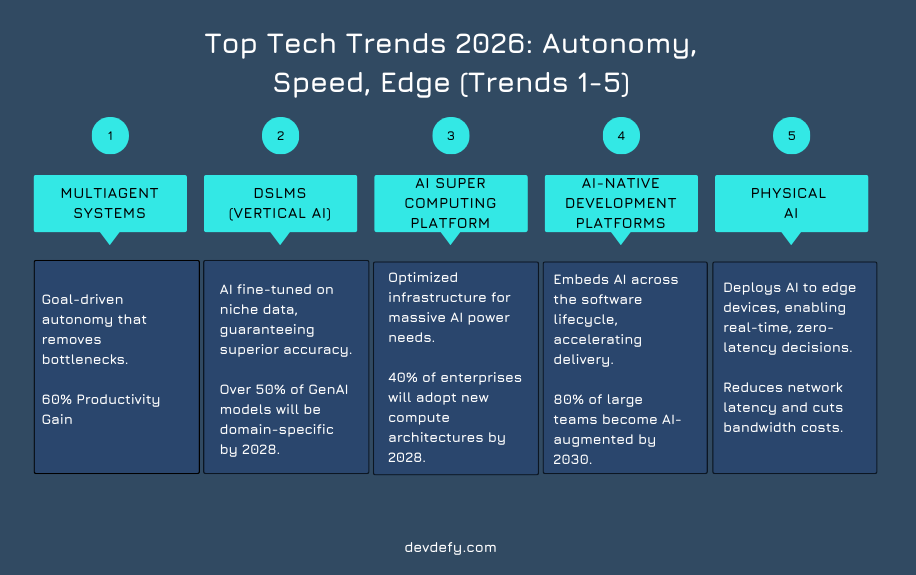
1. Multiagent Systems (MAS)
MAS means moving from fixed, step-by-step automation to true, goal-driven autonomy. These are sophisticated AI entities that act as virtual co-workers. They coordinate with each other to complete complex, end-to-end business workflows without constant human oversight.
1. The Change:
MAS eliminates the “human approval” delays that bottleneck systems like ERP and CRM. Early adopters report massive efficiency gains, with some seeing 60% productivity increases and faster decision-making.
2. Business Value:
Agents can autonomously analyze demand patterns, adjust inventory levels, place new supplier orders, or deploy ML models to detect and act on fraudulent financial transactions in real-time.
3. How to Prepare:
Autonomy requires control. You must implement strong governance through Retrieval-Augmented Generation (RAG) systems to ground agents in your proprietary data, preventing ‘hallucination’ and ensuring policy alignment.
2. Domain-Specific Language Models (DSLMs)
DSLMs (also known as Vertical AI) are hyper-specialized AI models trained exclusively on data, terminology, and regulations for a single sector (e.g., healthcare, finance, legal).
1. The Change:
DSLMs deliver superior accuracy because they inherently understand industry jargon, eliminating the need for elaborate user prompts. Gartner predicts that by 2028, over half of Generative AI models used by enterprises will be domain specific. This specialization provides a defensible competitive advantage.
2. Business Value:
You can design specialized AI models to provide medical or legal advice strictly grounded in proprietary protocols, guaranteeing high compliance and accuracy, or train proprietary ML Models to predict equipment failures with far higher precision than general models.
3. How to Prepare:
Success hinges on curating high-quality, domain-specific data. Partner with experts for ML Model Development to fine-tune open-source models or train a new proprietary model from scratch, ensuring scalability and performance for your niche needs.
3. AI Super Computing Platform
This trend represents a complete redesign of the server infrastructure, creating an AI-native platform optimized specifically for the colossal computational demands of training and running advanced AI models.
1. The Change:
Traditional data centers are inefficient for AI workloads. This specialized infrastructure makes large-scale AI deployment feasible, especially as power demand becomes a primary constraint. Gartner predicts that by 2028, over 40% of leading enterprises will adopt hybrid computing architectures into critical business workflows (up from 8%).
2. Business Value:
It provides the necessary computational backbone to run vast Multiagent Systems and execute resource-intensive tasks like molecular simulation and real-time risk modeling.
3. How to Prepare:
Preparing requires expert Cloud Services and Architecture Design to leverage hyper-scalable, large-scale cloud solutions, utilizing container orchestration (Kubernetes) and microservices architecture for guaranteed performance.
4. AI-Native Development Platforms
This means completely overhauling the Software Development Lifecycle (SDLC) to natively incorporate generative and predictive AI into every phase: design, development, testing, and maintenance.
1. The Change:
This platform delivers significant ROI by automating repetitive tasks, allowing human developers to focus on architectural design and problem-solving. Developers using AI report substantial efficiency gains, typically ranging from 10% to 25% in productivity.
Gartner predicts thatby 2030, this will result in 80% of organizations evolving large software engineering teams into smaller, more nimble teams augmented by AI.
2. Business Value:
Accelerated time-to-market for bespoke solutions through rapid prototyping and automated code completion. Automated regression and load tests ensure the reliability and security of high-performance applications.
3. How to Prepare:
The speed of AI code generation must be matched by deployment capability. Implement robust DevOps practices using containerization (Docker) and orchestration (Kubernetes) for smooth, scalable CI/CD deployment, a core Custom Software Development expertise of DevDefy.
5. Physical AI
Physical AI is the deployment of AI models directly onto edge computing hardware, enabling devices to process and analyze data locally, in real-time, right where it is generated.
1. The Change:
This eliminates the millisecond latency common with cloud-based processing, which is critical for real-time operations like autonomous systems or smart factories. It also reduces bandwidth costs and enhances data privacy by processing sensitive information locally.
2. Business Value:
Utilize Edge AI for asset tracking or monitoring machine health to trigger immediate, on-site corrective actions like instantly turning on a cooling system to prevent equipment failure without waiting for a distant cloud server.
3. How to Prepare:
This requires deeply integrated IoT Development Services. Design containerized cloud solutions that are seamlessly compatible with distributed edge nodes, utilizing platforms like AWS IoT and protocols like MQTT/CoAP for low-bandwidth environments.
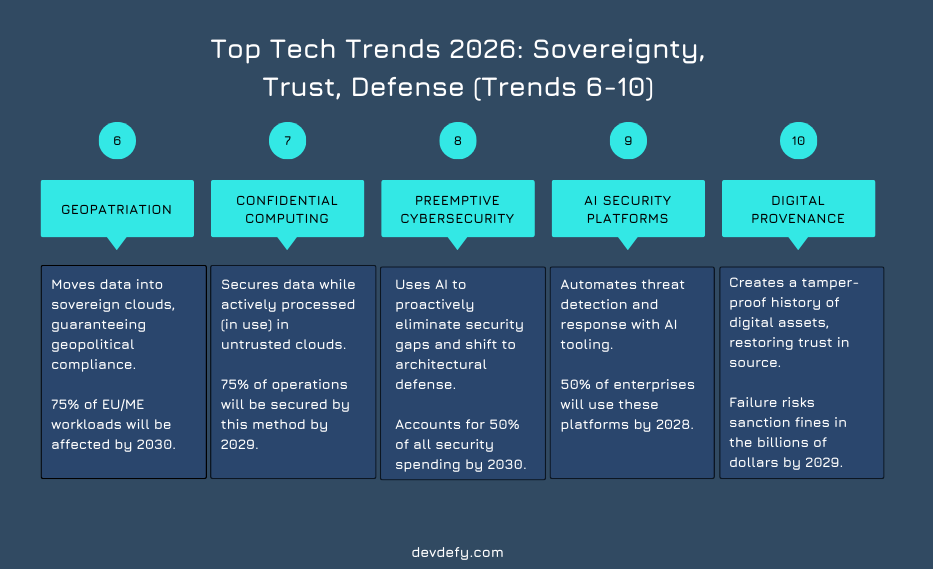
6. Geopatriation
Geopatriation describes the strategic necessity of moving company data and applications out of global public clouds and into local alternatives (sovereign clouds or regional providers) due to geopolitical risk and regulatory compliance.
1. The Change:
“Where your workloads live” becomes as critically important as “what your workloads do.”. Gartner predicts that by 2030, more than 75% of European and Middle Eastern enterprises will geopatriate their virtual workloads into solutions to reduce geopolitical risk. This guarantees compliance with mandates like GDPR and data sovereignty laws.
2. Business Value:
Re-architecting cloud platforms for regional providers ensures governance and legal control over mission-critical enterprise applications (e.g., healthcare, finance). It enables multi-cloud flexibility, avoiding vendor lock-in.
3. How to Prepare:
Leverage expert Cloud Servicesand Architecture Design to implement vendor-agnostic architecture. Use centralized key and access management (RBAC) and hybrid orchestration to enforce data boundaries and allow for seamless region and provider switching, guaranteeing geopolitical resilience.
7. Confidential Computing
Confidential Computing is a security framework that protects data while it is actively being used and processed by performing computation within a hardware-based, verified trusted execution environment (TEE).
1. The Change:
Protecting data “at rest” and “in transit” is no longer enough. Confidential Computing aligns with the highest level of Zero-Trust Architecture (Verify Explicitly, Assume Breach) by strictly limiting the “blast radius” of any potential intrusion.
Gartner predicts that by 2029, more than 75% of operations processed in untrusted infrastructure will be secured in-use by confidential computing.
2. Business Value:
Allows companies to securely process highly sensitive information (e.g., patient records, financial data) using cloud-based AI/ML models without exposing the underlying data to the cloud provider itself. This is vital for regulated environments.
3. How to Prepare:
Implementation requires a complete shift to the Zero-Trust model. DevDefy’s Custom Software Development methodology ensures every application incorporates robust data encryption, secure access controls, and network segmentation into the initial design, utilizing specific TEE features offered by cloud providers for compliance.
8. Preemptive Cybersecurity
Preemptive Cybersecurity moves security operations from a reactive, perimeter-based model to a proactive, foundational state. It uses AI and continuous verification to eliminate security gaps before they can be exploited.
1. The Change:
Preemptive security builds trust and control into the development foundation, enabling rapid AI and cloud adoption because security is integrated and automated.
Gartner predicts that by 2030, preemptive solutions will account for half of all security spending, as CIOs shift from reactive defense to proactive protection.
2. Business Value:
Ensures security principles and vulnerability assessments are integrated early into the Custom Software Development (DevSecOps) lifecycle, ensuring secure coding practices are used by AI-Native Development Platforms. Reduces the Mean Time to Resolution (MTTR) for security incidents by automating detection and response.
3. How to Prepare:
Implement Security Implementation at every stage of the development lifecycle. This involves performing regular vulnerability assessments, threat modeling, and integrating robust data encryption and multi-factor authentication directly into the software’s foundational architecture.
9. AI Security Platforms
AI Security Platforms are the specialized software and tools required to enable Preemptive Cybersecurity. They use AI and machine learning to analyze massive volumes of security data, automate the detection of problems, and execute remediation actions autonomously across the IT estate.
1. The Change:
These platforms provide a single, real-time, context-aware mapping of every data journey across code, infrastructure, SaaS, and AI systems, the foundational requirement for preemptive action.
Gartner predicts that by 2028, over 50% of enterprises will use AI security platforms to protect their AI investments.
2. Business Value:
Automatically verifies that all new deployments (from the AI-Native Development Platform) adhere to Confidential Computing and Geopatriation access controls. They utilize automated playbooks for immediate recovery actions when anomalies are detected.
3. How to Prepare:
The strategy requires a robust data foundation and the right tooling. DevDefy assists clients in integrating continuous monitoring and management practices (e.g., CloudWatch, Datadog) into the cloud deployment process to generate the necessary, high-quality operational data stream for effective AI Security Platforms.
10. Digital Provenance
Digital Provenance refers to the verifiable, tamper-proof history of a digital asset or data point, confirming its origin, chain of custody, and integrity from creation to current use, often using decentralized trust systems (like blockchain).
1. The Change:
In the age of generative AI and deepfakes, trust in data origin is collapsing. Digital Provenance restores that trust by providing cryptographic verification that ensures authenticity without intermediaries.
Gartner predicts that by 2029, those who failed to adequately invest in digital provenance capabilities will be open to sanction risks potentially running into the billions of dollars.
2. Business Value:
Critical for auditing compliance and ensuring the reliability of data used to train high-stakes Multiagent Systems and DSLMs. It’s used in supply chains to track high-value or ethically sourced products, verifying their authenticity.
3. How to Prepare:
Implementation relies on specialized Custom Software Development to integrate secure ledger systems or blockchain technologies with existing enterprise applications. Define the specific data points that require tracking, design the verification mechanism, and seamlessly integrate this trust layer into existing workflows.
Takeaway
The era of simple automation is over; the future demands a shift to deeply intelligent, self-managing systems. This paradigm shift is driven by the most critical technology trends 2026 has to offer, where AI moves from a passive assistant to an autonomous “agentic” workforce.
Achieving this enterprise autonomy requires a complete architectural reset: matching the massive speed of AI with robust, custom infrastructure, while ensuring security is built-in. This includes specifically addressing new geopolitical mandates for data control and continuous verification, core pillars of the technology trends 2026 landscape. Navigating this integrated, specialized transformation is complex.
Stop reacting to technological changes and partner with DevDefy today to transform these strategic imperatives into a custom, scalable, and resilient operational reality.